If your wheel is already direct drive, improving the brake pedal often makes more sense than buying a stronger base. A load-cell brake measures force rather than simply pedal travel, which can make repeatable braking easier to learn.
- You want more repeatable threshold braking
- Your pedals and seat can stay fixed under force
- You already have a usable wheelbase
- Your chair rolls backwards or pedals slide
- You only want stronger force feedback, not braking consistency
- You cannot comfortably generate the required brake force
Key specs & facts
| Primary benefit | Brake force consistency |
|---|---|
| Mounting need | Stable pedals + chair/cockpit |
| Best for | Drivers struggling with repeatable braking |
| Not automatic | Does not replace technique/practice |
Why braking matters so much
Lap time is often won or lost under braking. A load-cell system lets you build muscle memory around pressure, similar to the way a real car brake becomes increasingly resistant.
Wheel torque versus pedal feel
Moving from 5 Nm to 8 or 9 Nm improves steering strength and headroom. Moving from a basic position-based brake to a good load-cell pedal can change how consistently you hit the same braking point every lap.
You need a rigid mount
This upgrade only works properly if the pedals and seat stay put. Strong brake pressure on a sliding pedal set or rolling office chair becomes an exercise in furniture migration.
Fanatec example
Fanatec's CSL Elite Pedals V2 use a load-cell brake, Hall sensors and an all-metal pedal structure. They are a useful example of the type of upgrade to consider after a starter wheel-and-pedal bundle.
Why pressure is easier to repeat than pedal position
Your leg is good at learning force. A stiffer brake lets you build a repeatable relationship between pressure and braking instead of trying to stop the pedal at exactly the same travel point every lap. That is why braking upgrades often show up as consistency rather than spectacle.
The hidden cost: rigidity
A stronger brake exposes every weak point in a desk setup. Pedals can slide, wheel stands can lift and office chairs can roll backwards. Budget for the way the pedal set will be fixed before assuming a load cell is a drop-in upgrade.
Do not max out the brake force on day one
Start at a comfortable force, build muscle memory and increase resistance only if it helps. The goal is repeatability, not proving how hard you can press.
Calibration is part of the upgrade
After installing the pedal, set a maximum brake force you can reach repeatedly without lifting yourself out of the seat. Then calibrate the simulator around that usable force. An impressive maximum resistance number is irrelevant if you cannot hit it comfortably at the end of a race.
Consistency takes practice
A load-cell brake can initially make you slower because the muscle memory is different. Give yourself a few sessions before judging it. Use the same car and track, watch braking points and focus on repeating pressure rather than immediately changing hardware settings after every lap.
Desk racers need a plan
Wheel stands, wall stops, non-slip mats and caster cups can all help, but the system has to resist the force path from your leg through the pedal and chair. Solve that mechanical problem first or the new pedal will simply move the furniture more consistently.

MOZA SRP2 Pedals
Practical load-cell route for PC racers who can mount the pedals securely.
Amazon prices and availability change frequently, so we show a current Amazon UK link rather than copying a price that may be stale.

MOZA R5 vs Fanatec CSL DD 5 Nm: Which Beginner Direct-Drive Bundle Is Better?
Read next →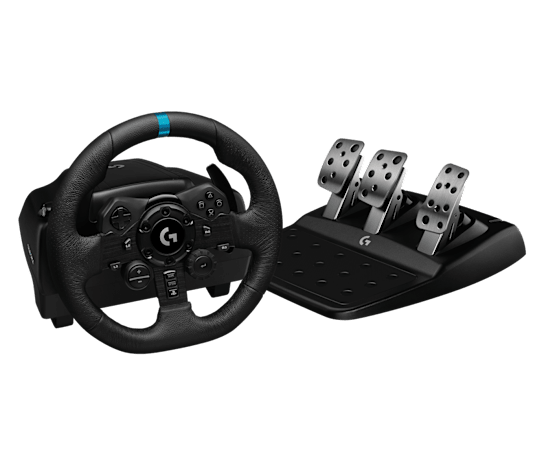
Logitech G923 vs Direct Drive in 2026: Is the G923 Still Worth Buying?
Read next →
MOZA R3 vs R5: Is 3.9 Nm Enough or Should You Start at 5.5 Nm?
Read next →Sources
Key specifications and factual claims are checked against manufacturer or primary-source material where available.
About this article
This page is a researched guide or comparison, not a claim of hands-on testing unless we explicitly say otherwise. Product specifications and availability can change, so important buying details are checked against current source material when the article is updated. Affiliate availability does not determine the underlying recommendation.